india dispatch #5: bundelkhand
Uttar Pradesh is the most populated state in India. A small village here may have five to ten thousand people. It abuts Delhi on one side, very close to where I’m staying. And you can travel through it for eight hours on a high speed train before reaching the other end, where it meets Madhya Pradesh. We did this in mid-April.
The Vande Bharat runs from Delhi to Khajuraho every day except Monday. It departs here at 6am, arrives around 2pm, and then turns around and comes back by 11pm. Khajuraho is a small town that’s become a tourist destination because of its 10th century temples. We were past the end of tourist season, so the train was fairly empty past the stop for Agra (the Taj Mahal). We emerged into the heat, which chose the day we arrived to begin in full force. It was a toasty 100 to 105 degrees for the entirety of our visit. This is currently a dry heat, not a humid one (that will come with the monsoons), but let’s just say it’s not particularly comfortable to be outside while the sun is out. I’m used to the sticky heat of New York City, with the asphalt baking and reflecting everything back at you in the summer. But it’s only ever like that for a couple of months, and the temperature is not consistently this high. This was completely different. I was walking slower and hiding in every sliver of shade I could find. All the local people we met seemed more accustomed to the heat and amused by my reaction to it.
Bundelkhand is a district stretching across the other end of Uttar Pradesh and part of Madhya Pradesh, the next state. We came to Bundelkhand to meet someone running an NGO focused on gender equity; specifically, educating men and boys to think about and take action on changing the inequalities that exist in their homes and communities*. In case you haven’t been reading the news**, violence against women is getting worse every day - and this is just what’s been exposed in mainstream media. Per the CDC, half of women experience sexual violence at some point in their lives. Based on my experience, that’s still an understatement, because so much sexual violence goes unreported. There’s plenty of rhetoric around what targeted groups should be doing to prevent violence against us (be aware of your surroundings, don’t dress a certain way, don’t go out late at night), and many non-profits supporting survivors of gender-based violence, but there’s not nearly enough work done on educating the people committing the violence: men. This non-profit is trying to break the cycle at the beginning, by engaging locals here in conversations on gender equity in ways that are familiar to them - by creating community, by selecting men in each village to run the meetings - and are acknowledging that this change in thinking does not happen overnight. We spent three days here meeting the people doing this work and the people living in this rural area.
We met the men managing the community groups in the villages, who shared how they have changed since joining this group. A popular refrain in the group translates to “the work of the house is everyone’s work”, meaning that it should not only be the woman’s responsibility, and the attitude should not be that a man is helping out with her work, but rather helping because it’s his work, too. We met some of these men’s families when we went to the villages as well. I was in shock at how much the women here do every day; not only are they managing their families and children and animals and food, but quite often they are also the ones farming. At lunch we ate local food, cooked (again) by the women; there was eggplant and arhar ki daal at every meal, both local crops. They showed us their farms, and everything they harvest, both familiar and unfamiliar. Berries, flowers, all the vegetables we ate in our lunches, fruits like wood apples, rice, and more. There were cherry tomatoes growing wild across the edges of several farms, and green mangoes that were still too sour for me. I tried out the hand thresher when we walked by one; it’s a solid upper body workout.
I haven't spent much time in rural India. My family is from the city here, and when we play tourist in India we’re generally visiting other cities. I realized quickly my Hindi was not cutting it. The locals speak a dialect called Bundeli. It’s still Hindi, but with enough twists and turns that I had to listen very carefully to pick up more than the gist of the conversation. In Delhi, English has become part of the city dialect, but that’s not the case in more rural areas. Also, because we were in agricultural villages, I learned words for the farm, the harvest, for growing, for wheat and chaff; the wheat harvest was just finishing when we arrived. Everyone was so welcoming and generous. While the men were a bit shyer to ask questions about me, the obvious foreigner, the women in the villages, especially those my age and younger, were very curious and didn’t hesitate. I couldn't help but consider the differences between us; we may be the same age, but these women have two, three, four children and so many responsibilities. It’s truly a life I cannot imagine, and yet, for the quirks of fate in a few generations, it might have been mine, too. Yet it was easy to ‘mix up’, as they say here, and we were all laughing and chatting for the few hours we spent together.
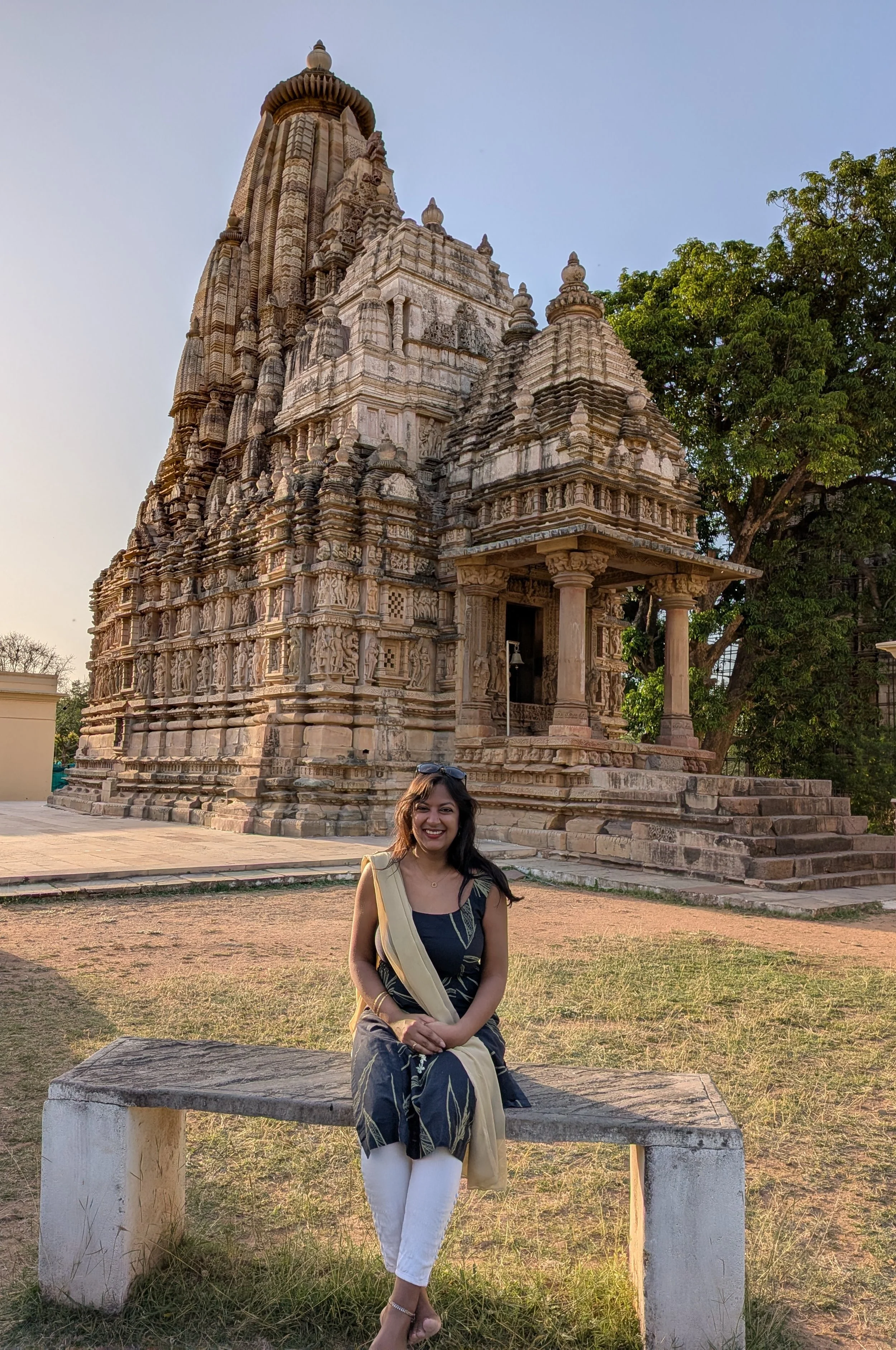
We returned to Khajuraho for one more night before heading back to Delhi, so we could see the famous temples. We went at 6:30am the next morning in an attempt to beat the heat. The western bloc of temples is a UNESCO site and one is required to take a government licensed guide along. One of the reasons these temples are so famous, along with their age, is their explicit erotic carvings. Our guide did not shy away from pointing these out, although his explanations for the carvings came with a heavy dose of misogyny. He repeated many times that these carvings indicated that women had no control over their desires. I bit my tongue several times as I knew any argument would go nowhere, but I was very tempted to set him straight. Most online sources indicate instead that these temples displayed a time of sexual liberation and when openness as well as respect for women’s pleasure existed. It’s a shame to think that ten centuries later we’ve moved backwards instead of forward.
We hopped on the train back to Delhi later that afternoon, after a little shopping and lunch. I was grateful for the AC, especially after waiting in the heat for the delayed train. It was nice to come home, but Bundelkhand has stayed on my mind. I hope I’ll be able to visit again someday.
*I want to note that while the NGO we met with is focused on doing this work in rural areas, this is by no means a problem that is isolated there. Plenty of educated men in urban settings commit violence against women and are more likely to get away with it because of their privilege.
**Look up the Epstein files, Gisele Pelicot, the recent expose on what some call the ‘rape academy’; there’s no shortage. This piece from Salon hits a lot of these points.